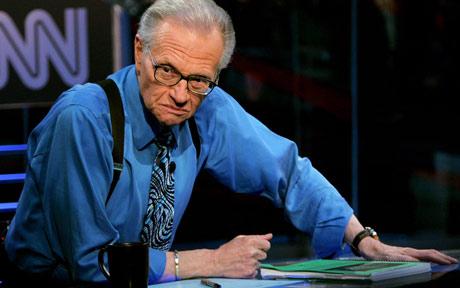
Larry King is Hanging up his Suspenders

Larry King announces his retirement after 25-year gig on CNN.

Larry King announced that he is retiring from his prime-time cable TV interview show on CNN, where he has been asking the tough questions to celebrities, world leaders and people in the news for a quarter century.

For me, the announcement is not just a sad note for King, but also an indicator of how long I have been in the news business. While all the American media have been talking about how King is a pioneer in cable news, I was stuck with the thought that I remember King vividly as a national late-night/early morning radio talk show host. It was on radio that he deftly honed his interview skills making him adept at talking with anyone and everyone.

Larry King is also a study in media trends. His career has successfully spanned different mediums, but his ability to draw on the latest newsmakers and storylines kept him current for decades.

In the media—as well as in public relations—the mode of how news is delivered is ever changing.  Yet, the power of the story and the storytelling will determine its success.

Good luck, Larry on your next chapter. Who knows? King might start doing interviews on Twitter.
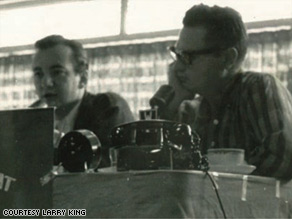
In 1959, Bobby Darin, left, was Larry's first major guest on his WKAT radio program.

The Price of Good PR: Paying for your own Championship Party

54400660[1]Does the price of an NBA Championship include the tab for the citywide celebration after the winning buzzer sounds? In Los Angeles, the answer is yes. 

The Los Angeles Lakers will likely be amending their annual operating budget to include a season-ending party.  In tight economic times, the Lakers ownership faced criticism last year after beating the Orlando Magic for the cost of a parade and citywide celebration. 

After this year’s defeat of the Boston Celtics, the Lakers wasted little time announcing they will pay the bill for the 16th championship parade through the city of Los Angeles. In coordination with city officials, the Lakers response to the potential negative community relations was swift and professional.

The direct response shows that businesses that step up, get in front of the story and take responsibility will be praised in the public light. The Lakers saga shows that even in the height of success, businesses must stay alert to protect their public image.

With this public relations move, the Lakers are champions on the court, as well as off the court.             

54400354[1]

The World Cup of Reputation Management

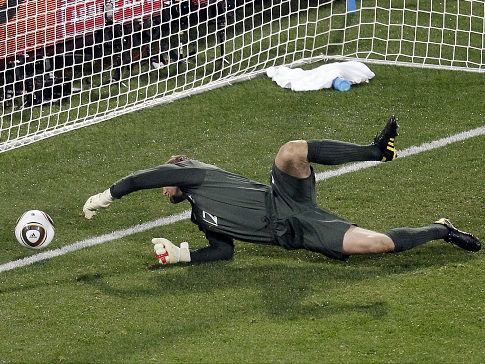
Shot bounces off Robert Green's hands and into the net in the U.S. vs. England's 1-1 tie. (Sohn/AP Robert)

Advertisement for the 2010 World Cup touts that one game changes everything.

How right they are. One defender caught napping—or an unfocused goalie (need we mention England’s Robert Green?)—and a game, if not an entire cup, can be lost.

Lose a game. Lose a chance at greatness.

The same tagline also applies to reputation management.

Just ask Helen Thomas, the veteran White House correspondent, who made some inappropriate and untimely comments about Israelis. She was forced to hastily retire – ending her more than 50-year journalistic career in disgrace.

Just ask the BP CEO Tony Hayward, whose multiple gaffes have made him such easy pickings that the late night joke writers don’t even have to try.  A leadership change at BP would not surprise many insiders.

The only people likely happy with BP’s troubles are Toyota, who have fallen off the front page because their recent mistakes have been washed away by bigger, newer examples of poor reputation management.

One misstep…and years of golden reputation and favorable public image can be tarnished forever.

The Power of a Good Mea Culpa

-by Frank Wolff, Media Relations Director

BP CEO Tony Hayward
“What the hell did we do to deserve this?” BP CEO Tony Hayward

Here’s a PR tip that applies to BP and all businesses big and small: don’t underestimate the power of a good mea culpa.

Merriam-Webster defines mea culpa as a formal acknowledgment of personal fault or error.

Let’s say you happen to spill a few million gallons of crude oil into the ocean. That requires a super-size mea culpa. That’s the source of a lot of the public’s frustration right now. They’re hearing everything from excuses to rhetoric to things they can’t believe are coming out of the mouth of BP CEO Tony Hayward. Here are some Hayward quotes from a Newsweek story.

“What the hell did we do to deserve this?”

“…the Gulf of Mexico is a very big ocean. The amount of volume of oil and dispersant we are putting into it is tiny in relation to the total water volume.”

“…the environmental impact of this disaster is likely to be very, very modest.”

“…there’s no one who wants this over more than I do. I would like my life back.”

And the company wonders why the public is livid?

best-buy
"The manager at a major electronics store (we’ll call it 'Best Buy') would have been wise to opt for mea culpa"

Mea culpa also does wonders on a smaller scale. For instance, the manager at a major electronics store (we’ll call it “Best Buy”) would have been wise to opt for mea culpa after discovering that a customer (we’ll call him “me”) has been waiting for three weeks for an item to arrive that he was told would arrive two weeks ago. After several unreturned phone calls and two trips to the store, the manager discovered that her expert salesperson ordered the wrong item for the customer and the item that customer really needs can only be ordered online. She could be a graduate of the Tony Hayward school of PR , as she opted for a “not my fault” attitude. The customer was given $5 in free shipping, but all he really wanted was a sincere mea culpa and her best effort to make the situation right.

Regardless of whether you’ve fouled up a customer’s day or fouled an entire ecosystem and the livelihood of thousands of people, the advice is still the same: always start with a good mea culpa.

Fact is—The Media Likes Facts

arena-bathroomI enjoy The Count column in The Wall Street Journal. The column has interesting numbers and stats about sports or the sporting community. On Wednesday, WSJ reported in a big bold red number a fun fact about the new Consul Energy Center in Pittsburgh:

250Number of local college students that are being recruited to simultaneously flush all the toilets in the Pittsburgh Penguins’ new arena to test water flow.

The sophomoric teenager still lingering inside of me (thanks in part to my 12-year-old son) will always stop at a flushing toilet fact. But more importantly, people interested in getting quality public relations buzz should remember that facts – especially those that are easy to understand – will often get the attention of the media.

So don’t flush potential media coverage by filling your copy with marketing speak instead of facts.

Panhandle Tourism Takes a Hit Even Though Beaches are Beautiful

Destin, Fla.
Destin, Fla.

The beaches in Destin, Fla., were beautifully clear this past weekend for Memorial Day. Yet many of the visitors stayed away.

No oil or tar balls have hit the pristine Florida panhandle. Still, patrons are afraid. The key drive markets throughout the South have seen constant coverage of oil in the Gulf.

We have had the pleasure of representing resorts and vacation homes across the panhandle, and what is unfolding is another undeserved blow for the region. For the past three summers, many of the resorts suffered thanks to the economy. The mayor of Destin told CBS Evening News this was supposed to be the recovery year: The year when people from Memphis, Birmingham, Atlanta and points beyond ventured back to these wonderful Florida beaches.

Oil has caused the recovery to slide off course.

Florida officials have said it will take a concentrated effort to tell tourists that it’s still okay to enjoy the Florida beaches. They are right. No matter what happens with the oil, it is going to take consistent and honest reporting of the beaches’ conditions for the tourists to have the confidence to return in full force. Educational public relations is going to be key for full recovery.

Perception – unfortunately for Destin, Fla. – is reality. The facts say the coast is clear for now. Some tourists are not taking chances and have picked other summer fun spots.

Recovery is coming. But with an uncapped oil well not expected to be resolved soon, that elusive recovery will likely have to wait.

Destin is destined to give great travel deals this summer. This wonderful community deserves support.

fl_destin_6164[1]

A lesson in bad media relations

There was an old Saturday Night Live sketch that featured a character named Leonard Pinth-Garnell . He was an arts critic who showcased the worst in everything; Bad Playhouse, Bad Cinema, Bad Opera, etc. The audience got to witness a truly awful performance.

Today we’ll borrow a page from Leonard Pinth-Garnell for an installment of Bad Media Relations. KGO-TV in San Francisco was doing a story looking at how money in a hospital patient gift fund was being spent.

Watch as the hospital community relations director touches investigative reporter Dan Noyes a couple dozen times and then shoves his hand in a camera lens. It’s one of the most bizarre PR-media encounters you’ll ever see.

The station says it went to a community meeting to try and get an interview after the hospital ignored its phone calls. This is a standard practice, and an excellent reason to not ignore repeated phone calls from a reporter. Not calling back is basically an invitation for the I-Team to show up unannounced.

The PR person says the reporter purposely disrupted the meeting and the hospital says the story was unfair and distorted the facts. You can read statements from both here.

This ugly scene was easily preventable. Call the reporter back and find out what they are working on. Work with the hospital administrators and defend your position if you believe what you’re doing is right. Do a sit-down interview with the reporter, or at least provide a statement or written answers to his questions.

Handle your media relations properly and you have a story that you may not like on one TV station. Bungle your media relations and your story is now all over major news sites and the video of your bizarre tactics are there for all to see.

To quote Leonard Pinth-Garnell: “Stunningly bad!”

Modern-day Public Relations: Social vs. Traditional Media

Pew Examines how blogs and social media agendas relate and differ from traditional press
Pew examines how blogs and social media agendas relate and differ from traditional press

Public relations isn’t just about getting in the local newspaper these days. The new mantra, for some, seems to have become “Extra. Extra. Read all about it (on Twitter).”

While traditional media should never be disregarded, it is important for your PR team to take a broad approach and deliver your message, brand or service to as many eyeballs as possible.

Step one in this process: understand the different types of stories/messages that social and traditional media gravitate toward.

According to a recent study by the Pew Research Center, new media (blogs, Twitter, YouTube) and traditional media (newspapers, magazines, TV) focus on different issues most of the time. Blogs, for instance, led with the same story as traditional media in only 13 weeks (of a 49-week period).

Social media site Mashable noted that the study underlines a large disconnect between what mainstream media thinks is “top news” and what social media users consider newsworthy.

Still, traditional media remains important. While the leading stories differed most of the time, 80 percent of blog stories still come from just four legacy networks or newspapers: the BBC, CNN, the New York Times and the Washington Post.

Let us know what you think via our own social media networks. Join Wellons Communications on Facebook and Twitter, or check out our new multimedia clip book, using the Endavo Media Player.

Former Florida Senator Graham to serve on Gulf Coast oil spill panel: A lesson in crisis PR

Former Fla. Sen. Bob Graham to head presidential oil spill panel

The Orlando Sentinel reported in its Sunday edition that President Obama has selected former Senator Bob Graham to lead a bi-partisan panel looking into the devastating oil spill. The spill threatens an untold number of industries including the Gulf of Mexico seafood and tourism.

The administration and oil giant BP have come under fire for their handling of the crisis.  Graham was gracious in accepting the assignment. He gave a subtle lesson in media relations and crisis communications when talking to reporters over the weekend. He addressed questions frankly and honestly without casting aspersions.

Graham told the Orlando Sentinel:  “I have been following it all, but I’m reticent to talk about any personal assessment because we are going to get to know a lot more over the next few months; I don’t want to pre-judge our conclusions.’’

The senator’s quote is well done. In one sentence Graham said he was educating himself, not going to get personal, open to solutions and will say more when the facts are in. Too bad not everyone involved is this crisis is as thoughtful with their public statements as the retired Senator.

Oh, Snap. It’s the Story that Sells…Sometimes.

Silly Bandz
Silly Bandz

–by Sarah Harmon, Account Executive at Wellons Communications

As an over-eager 20-something working in public relations—and with several exciting clients at Wellons Communications—I thought I knew it all. My axiom: The better the story; the better the media coverage.

Enter “silly bandz.”

The generation gap must cut off at 27 because I just don’t get it. These are multi-colored rubber bands shaped like animals, food, musical instruments and anything else not resembling a circle. And at nearly 4 bucks a pop and up, they’re the hottest accessories (worn around the wrist, I’m told) since slap bracelets and biker shorts.

On the surface, there’s no story. I mean, seriously, we’re talking rubber bands here. Yet these silicone squigglies take up entire feature stories in The New York Times, CBS News and the Orlando Sentinel (with a focus on the Disney bandz, of course).

While the better stories are still going to get the most attention, this goes to show you—with enough hype—almost anything can sell.

Jump on the Wellons Communications “bandz” wagon by joining us on Facebook and Twitter.

bilde


2025 © Wellons Communications | Orlando PR Firm. All Rights Reserved.