
Are you too much in love with social media?

Social media—and its hold on businesses that are seeking to sell to those millions of fans—has dramatically changed how we market to wanna-be clients.

Businesses like to call on social media because it is relatively inexpensive, allows rapid formulation of messages and makes it easy to distribute information.

But how effective is social media? Does it really sell things and ideas? Or is it more “white noise” in a world where communications have become overloaded?

Social media’s sheer volume offers opportunities to influence customers 

Consider this: According to Social Media Today, “…. (the) total time spent on social media beats time spent eating and drinking, socializing, and grooming.”

That’s a lot of time. And that huge chunk of everyone’s daily life offers a tremendous marketing opportunity. But simply lobbing information on an indiscriminate basis without an organized plan and strategy is not the answer.

Because social media is so prevalent, businesses in love with social media often spew out tons of information that may not, in fact, be “share-worthy” or even interesting. That leads to less-than-satisfactory (or no) results and wastes the time and energy of the business.

In short, there’s more to it than simply “Let’s post a lot of news, information, and graphics on Facebook and Instagram.”

Social media CAN work, but only if it is based on newsworthy information

Cision, who prospered for decades as a leading press release distribution company, has morphed to a distributor of information via electronic resources.

Even though the means of distribution has changed, Cision has never varied from its belief that whatever information is shared, it has to have some value to both the reader and the organization that is issuing the news.

Cision’s philosophy is encapsulated the still-relevant article 7 PR mistakes to avoid in 2017. The theme of the article can be summed up in two ideas: you have to distribute information to reach your audience and your information has to be relevant.

So how do we approach social media at Wellons Communications?

We still subscribe to the old 5 W’s—who, what, when, where, why and how—but supported by modern technology and adjusted to fit prevailing attitudes.

When you put the new technology and attitudes aside, it still comes down to  clearly identifying who can use your information, when they can use it, and clearly stating and explaining why your message matters.

How we go about that is more complex. How and what revolves around putting together a well-thought out plan that integrates messaging and timing and generates results…. all without breaking your bank

We certainly believe social media is paramount in today’s communications environment.

But we look at social media as a means of distribution, not the “magic bullet” that makes people buy products, services and ideas. Posting information on the Internet doesn’t necessarily mean sales will skyrocket. It simply means you have distributed information.

At Wellons Communications, we take a total approach to public relations. We recognize the power of social media, but we also understand the value of traditional public relations, marketing, content, SEO and more.

They all work together to move the needle for clients, and no one plan fits all. There is only one plan that works—and that plan is the one that is best suited to accomplish your marketing goals, within your budget, and delivering the kinds of results that will enable your profitability and success.

Social media is more than likely part of that plan—but if you’re only doing that, and if you don’t have a clear idea of why, it may be time to rethink the relationship.

As you plan ahead and seek to more actively involve public relations in your overall marketing, keep Wellons Communications in mind.

We’re mindful that you only have so much money to invest in marketing and eager to help you use PR to serve as an affordable and reliable means of augmenting and strengthening your overall marketing program.


Social media check-up: Is your business healthy?

With more than 2 billion people on social media, we’d be surprised to find someone who doesn’t think it’s important for his or her business.

Whether you’re just getting started or you’re a seasoned pro, social media inevitably comes with a lot of questions. Am I doing this right? Am I getting the most out of it? Where do I even start? We’ve heard them all.

And we can relate! Social media has been on our minds at Wellons Communications lately. Our CEO recently led a workshop on social media, and as a staff, we did a deep dive on best practices across platforms.

A short check-up never hurts. Below are five essentials for your business’ social media—so you can be sure you’re in tip-top shape.

  • Know your platform
    There are a multitude of social media platforms out there, from Facebook and Instagram to LinkedIn and Google+. Each platform operates differently, attracts a different demographic, and has different requirements. For instance, Instagram is driven by visuals. LinkedIn attracts a more professional crowd. Twitter allows the use of hashtags. Understanding each platform and selecting the right ones for your business can set you up for success.
  • Set a strategy
    Just like with any other marketing and public relations tactic, you must establish a plan. Jumping head first into social media without setting a strategy is like driving down a dark road without headlights. Eventually, you’re going to crash. Ask yourself what you want from social media. Do you want direct ROI? Do you want to be seen as a thought leader? Your goals will drive the strategy you use.
  • Craft your content
    What you post on social media defines your company, just as much as a sales presentation or your website. Content shows viewers what your company is, what it does and what it stands for—so it has to support your goals. What does your brand want to convey? What is your aesthetic, visually and tonally? Do you post videos, photos, articles or something else? Take some time to set some brand standards. After all, posting to a personal account is not the same as posting to a business page.
  • Stay consistent
    To effectively use social media, you have to be engaged. That means posting regularly (this is where that plan comes in!), responding promptly to comments and concerns, and actively listening to what is being said about your company on social media. Are you doing all you can to protect your reputation and keep your voice out there?
  • Keep up-to-date
    The social media landscape is constantly changing and growing. It’s essential to stay in the conversation and up-to-date on the latest trends to remain relevant. Are you reading up on changes on platforms or best practices in your industry? At Wellons, we make sure to brush up periodically to make sure we stay sharp.

If you still have questions or want to ensure your company is getting the most out of this powerful tool, don’t hesitate to reach out. We’d love to share our knowledge and expertise with you. Give us a call at 407-339-0879 or email Will at will@wellonscommunications.com.

Have a Laugh: Use Humor on Social Media

Dr. Seuss once said “From there to here, and here to there, funny things are everywhere.” This couldn’t be more true for social media. When brands get in on the humor, social media is even more fun. Here are 3 reasons why your brand should consider using humor on social media:

Attention Grabber: We all mindlessly scroll through our social feeds during the day, sometimes it’s the same information, over and over again. When a funny video, picture or post pops up on the screen, you can bet we’re going to stop, read it and like it.

Old Spice TweetRelatable: Humor shows that brands have a human side. They don’t always take themselves too seriously, and can laugh. Relating to your audience is a guaranteed way to increase engagement.
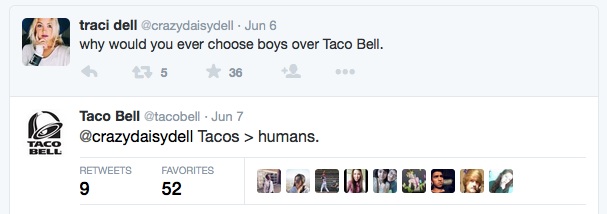


Taco Bell Tweet

Memorable: When your audience sees a funny post, they’re more likely to share it and remember it when it comes to making a purchasing decision. Take advantage of this by creating memorable content. Take this Virgin America post from Thanksgiving 2014, for example:

Virgin America Tweet

Tracking the Invisible – Analytics for Social Media Images

Social media has become increasingly more image-based. This fact can be attributed to why platforms like Instagram and Vine are increasingly on the rise. Here are some quick stats:

  • According to 2014 research published on eMarketer, photos accounted for 75% of content posted by Facebook pages worldwide.
  • Photos and images are also the most engaging type of content on Facebook, with 87% interaction from fans.
  • For Twitter, adding a photo URL to your tweet can boost retweets by 35%.

Knowing this is great for content marketers. However, for those attempting to track mentions from followers and engage their brand in the conversation, this is a challenge.Analytics

How do you find a great post to “regram” on Instagram if no one tags or adds a #YourBrandHere to their post? How do you respond to customers on Twitter who don’t include your handle? How do you respond to Facebook users who don’t post directly to your page? How do you track the analytics to show your boss that social media is worth the time?

Nearly 85% of posts that contain a logo contain either no text or no text that is relevant to your brand, according to Brian Kim, director of product management for ad-tech startup GumGum.

If the visual elements going on social media largely elude the tracking and analytics brands use to keep tabs on what people are saying, how can we give an accurate picture to our clients about what’s being said about them?

Our recommendations:

mantii_th4

Enter the new social media analytics platform, Mantii. This platform is an offshoot of GumGum. Mantii looks for all or part of brand logos contained in social media posts, whether they mention the brand in text or not.

reverse google image search

Another method is to track your own images being shared through a reverse Google Image search. Google’s search by image can easily give you the information you need about your own pictures being shared by others.

curalate logo

A final method is to use the platform Curalate. Curalate applies image-recognition algorithms to social media platforms, much like Mantii. However, this platform is officially recognized by Pinterest, Tumblr and Instagram.

Have you used, or plan to use any of these platforms? Or are you using a different platform to track your images? Let us know in the comments.

ICYMI – Social Media Platforms Widening Advertising Options

Instagram introduces carousel ads, Pinterest expanding promoted pins

In case social media advertising and marketing wasn’t complicated enough, more platforms are expanding their promoted content offerings. Instagram and Pinterest are both expanding their promoted content services, and they are both making their advertisement options unique.

Instagram Logo, Instagram carousel adsInstagram:

Earlier this month, Instagram introduced their new idea for promoted content: “Carousel Ads.”

Carousel ads give brands using promoted content advertising more flexibility in telling their stories.  Viewers of these ads will be able to swipe left to see additional images and link to a website of the brands choice. Instagram says that this will “bring the potential of multi-page print campaigns to mobile phones.”

The new kind of ad will allow advertisers to be more creative. For example, a fashion company could deconstruct the individual pieces in a “look” and link to where potential customers could by them.

Click-through links give advertisers another way to drive traffic to their website and drive sales.


Pinterest:

Our Pinterest home-feeds have become flooded with Promoted Pins.pinterest-logo-transparent

As of the first of this year, Promoted Pins became widely available to advertisers. These pins are paid for by advertisers and appear in the dashboard of users that match the advertisers’ brand’s interests and relevant search results. Much like Facebook, Pinterest allows you to target your promoted pins and uses analytics so advertisers can see how their campaign is going.

Now, Pinterest claims that Promoted Pins perform just as well and sometimes better than organic pins, and that brands across all industries saw results. But if your consumer base is anything like this blogger, they will have nixed most of the “Pins Based on Your Wedding/Food/Style Board” pins in no time flat.

Time will only tell how well Promoted Pins does and whether it’s worth investing in. In the meantime, we’ll be watching for more research.

On a related note, Pinterest said that their Auction-based Promoted Pins (CPC), or cost-per-click model is seeing impressive results for their beta users. However, they’re not quite through working out the kinks, and it’s not ready for mass use.


So if you didn’t have enough on your plate with Facebook’s ever-changing algorithms and advertising options, we’ve just added two more to your list. Do you think these options are viable for your business? How do you plan on keeping up with different social media platforms?

2025 © Wellons Communications | Orlando PR Firm. All Rights Reserved.