
“There is a permanent record today and it is called the Internet”

Privacy is a commodity. In today’s world dominated by the Internet, anything and everything can be posted instantaneously and shared with millions in mere seconds. David from “David After Dentist” would agree. However, privacy concerns are no laughing matter. Vigilance should be taken to ensure that the next breaking news scandal that hits the front page of Yahoo does not revolve around you, which is why we’re shaking our heads at Mitt Romney this week.

After secretly recorded comments from a private Boca Raton fundraiser leaked of Mitt Romney saying that 47% of Americans are victims dependent on the government, we can’t help but wonder why the aspiring President would vocally disparage almost half of his country. Here’s a tip for you Mitt Romney: if you are running for President, everything you say and do WILL be held against you in the court of public opinion, thanks to the Internet. The video was leaked to the press, and now everyone from Jon Stewart to Diane Sawyer is spreading the remarks to their audiences; meanwhile the Mitt Romney campaign has spun its gears to full-on damage control.

Another unfortunate recent example of the royal lack of privacy today comes from an Italian magazine publishing topless photos of Kate Middleton. The Duchess of Cambridge was simply enjoying a sunbathing session on a secluded French chateau getaway when a paparazzi photographer captured the scene. Now, the British royal family is taking the matter to court with hopes to stop further publications from printing the photos, but you can’t take back what has already been done. Amazing what a zoom lens and internet connection can do to the public image of a Princess.

Even the common person is not immune to the repercussions of online activity. Everything that you post, from Facebook cover photos to the latest Tweet about what you had for dinner, becomes fair game when you click “publish.” Alan Dershowitz, a Harvard law professor and lawyer for high-profile defendants, says that young people nowadays don’t seem to value privacy. “They put stuff on Facebook that 15 years from now will prevent them from getting the jobs they want,” he said. “They don’t understand that they are mortgaging their future for a quick laugh from a friend.”

And that’s nothing to laugh about.

Mac users steer to more expensive hotels on Orbitz

Many Mac users are fanatical about their computer and are willing to pay extra to own the brand.

Those same Mac users apparently also like to spend a little more on hotel rooms. The online travel agency Orbitz says Mac users spend as much as 30 percent more than PC users on the average hotel booking. The Wall Street Journal reports that the online travel service is showing Mac users more expensive properties.

Orbitz is experimenting with showing different hotel offers to Mac and PC visitors. The move is raising eyebrows and attracting front-page attention. The online travel agency is following a growing trend using predictive analytics to target potential buyers. Orbitz is quick to point out that both Mac and PC users can still rank hotels by price if they wish.

Companies used to just track what websites were being looked at, now they are tracking what computing system are being use.

Budget conscious Mac users should be cautious. Orbitz is likely to begin using the same algorithms to show rental cars and airline flights.

For PC users – especially those with broken hinges on their three-year-old laptop – expect to see more budget-friendly options on the front page of your online travel agency.

Social media a part of FCAT’s Path to Success to better communication

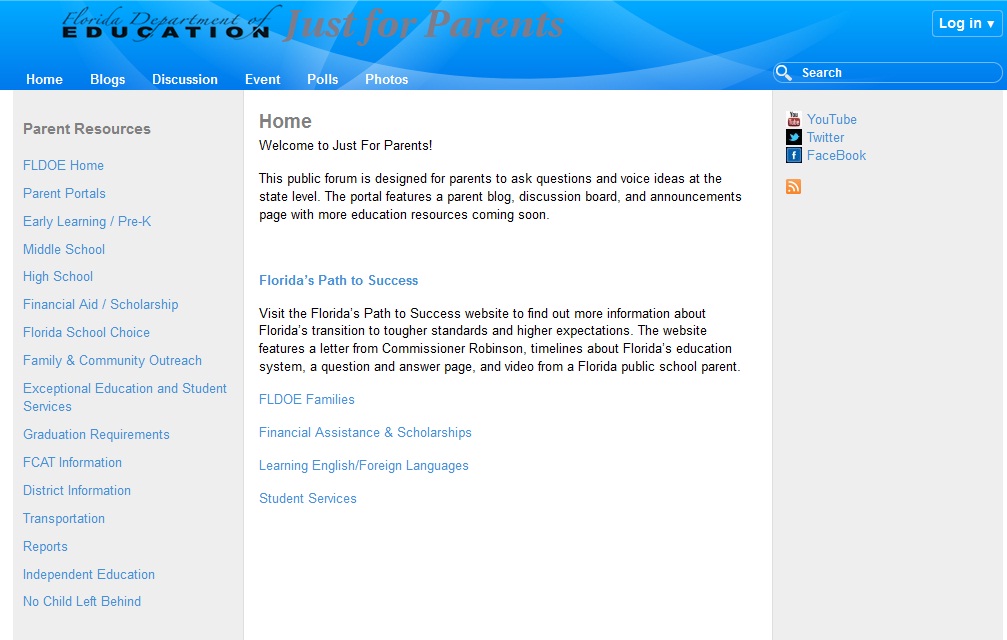
In light of public outrage from FCAT scores drastically plunging this year, the Florida Department of Education launched two websites Monday as part of its campaign to communicate with parents. One website, floridapathtosuccess.org, provides them with information about the department’s goal of transitioning to tougher standards, while the other, parents.fldoe.org/home, serves as an outlet for them to ask questions and express concerns on a discussion board. In less than 24 hours of its debut, three topics were posed by parents on the discussion forum, with a FLDOE representative already replying to two of them.

This response by the Florida Department of Education showcases how the organization is taking steps to communicate better with its core audience and increase transparency in the communication process. At a time when many parents are up in arms about recent headlines, creating these channels to interact directly with parents is a smart move on FLDOE’s part to take control of the situation. Instead of letting all the worry and frustration from parents fester, the department is tackling this challenge head on and trying to remedy the situation by supplying an appropriate space for them to vent and get answers to their questions from an authorized source – a commendable effort by the FLDOE and certainly a good public relations example of using online resources to foster two-way communication.

Facebook frenzy in the Zimmerman case

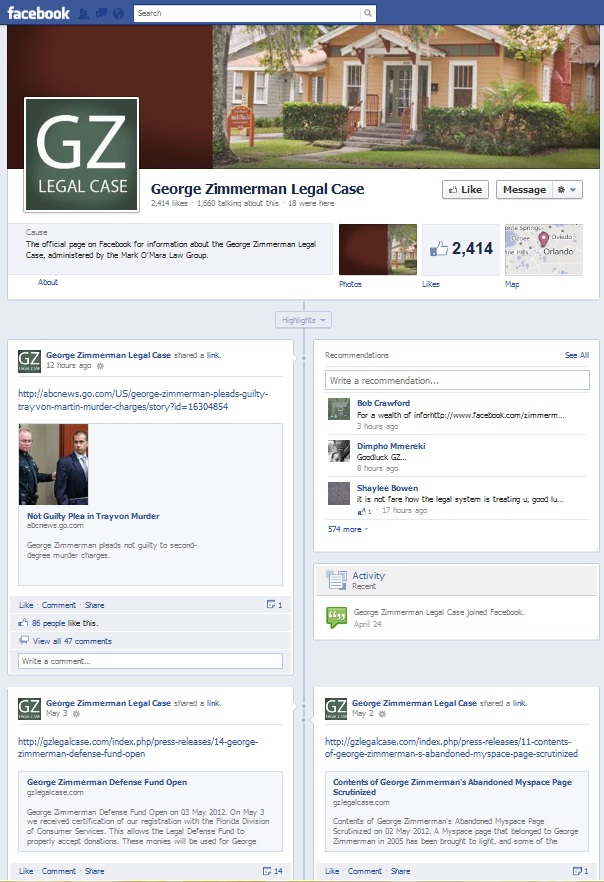
Social media sites have transpired past our everyday lives and into the courtrooms. Just look at the Trayvon Martin case and current trial against his killer George Zimmerman. Zimmerman’s team of lawyers has now entered the social media fray by creating a blog, Twitter and Facebook accounts to interact with the public, sparking interest and conversation. Recently, the George Zimmerman Legal Case shared a link on their Facebook to a blog article about Zimmerman’s abandoned Myspace page. In just four hours, the post had one share, seven “likes” and 93 comments.

With that said, the Zimmerman defense team may have bitten off more than it can chew. Media exposure has made George Zimmerman a household name and the face of evil. Their tactic of trying to shape public opinion of the most vilified man in the nation is an admirable effort, but the consequences have revealed that these social media labors can be detrimental to their cause. With dozens (sometimes hundreds) of comments popping up every time something is posted, we can see that the perception of Zimmerman continues to spread and swell. The handler of the Facebook account is threatening that any discussion or speculation on the facts of the case will be deleted, but that is not enough to control the catalyst of negative opinions brought on by every post.

Only time will tell how George Zimmerman’s legal defense team will handle such heightened criticism of their high-profile client and whether their online efforts will pay off. Either way, this case has certainly proven to be an interesting experience showcasing the evolution of social media.

Reputation Management in a Modern World

“Glass, china and reputation are easily cracked and never well mended.”
– Benjamin Franklin, “Poor Richard’s Almanack”

Long gone are the days where figureheads of corporations remain in the shadows. Now, news outlets and the public are putting the spotlight on these bigwigs, often exposing their misdeeds in the process.

Best Buy is a recent example of this. Two weeks ago, the CEO of the consumer electronics giant, Brian Dunn, resigned after the company opened an investigation into his “personal conduct.” There was speculation that he misused company assets to contribute to an alleged relationship with a female subordinate.

Another high-profile case involves University of Arkansas head football coach Bobby Petrino, who was recently fired from his multi-million dollar gig for violating a morals clause. The crime? He had a secret affair with a recruiting coordinator for the Arkansas football team.

These examples highlight two important lessons related to reputation management and the media. First, political leaders are no longer the only ones to have their personal lives catapulted to the front page; no one is safe from the scrutinizing eyes of the customers or shareholders. In fact, everything from financial records to emails to cell phone text messages can sometimes be fair game to the press thanks to the Freedom of Information Act.

Good reputation management involves being aware of the fact that nefarious activities in your personal life can easily cross-pollinate to news outlets and spread like a virus. It takes just one blow to your credibility to dismantle the years of hard work building that reputation.

Secondly, we learn how personal reputation is not the only concern in these scenarios. As shown from the Dunn and Petrino issues, organizations believe their image is tied to that of their employees. This is nothing new, as noted by Cees B.M. van Riel and Charles J. Fombrun in their 2007 publication, “Essentials of Corporate Communications.” They termed the phrase “media mania” to refer to this trend of how companies and their top executives now perform in the media spotlight. The book also states that chief executive officers in particular act as spiritual and emotional symbols of the organization, so it is especially important that these figures adhere to the same values and ethics of the companies they represent.

In this day and age, technology has allowed media outlets to report and deliver news instantly, which means they are quick to pounce on breaking scandals in politics, corporations and even football fields. Organizations have certainly taken notice and become more critical with media monitoring and reputation management, showcasing how they may react to threats by removing scandal-plagued employees from payroll, like what Best Buy and the University of Arkansas did to their offenders.

It also helps if the immoral acts weren’t committed in the first place, either.

Carl’s Jr. and Hardee’s know how to spice-up their brand image

With so much advertisement constantly being produced, it can be difficult to target a specific demographic and receive the response your advertisements look for – difficult, that is, for everyone except Carl’s Jr. and Hardee’s.

Known for their racy ad campaigns featuring young female pop-culture icons, Carl’s Jr. and Hardee’s once again proved that they know who their target audience is, and they know how to capture their attention.

In the most recent Carl’s Jr. and Hardee’s campaign, Sports Illustrated model Kate Upton appears in a classic drive-thru setting, eating a spicy Southwestern Patty Melt. The ad features Upton reacting provocatively to the “hot” sandwich, prompting many ad viewers to feel the heat.

Considering that the fast-food chain ads are targeting men ages 18-34, it’s no surprise that the campaign generated a lot of internet buzz. In fact, the campaign has been so popular that Carl’s Jr. and Hardee’s have enjoyed more than 120,000 new Facebook fans, a 104 percent increase in website visits and more than 5,000 Upton-and brand-related Tweets since the campaign launched.

The success of the campaign is an excellent example of how knowing your target audience and establishing your brand can propel any company into superstardom. What Carl’s Jr. and Hardee’s have accomplished is the difficult task of successfully targeting a very specific audience in such a well-developed way that a small portion of the population generates the most social and website traffic.

Without an understanding of their target audience, the amount of success Carl’s Jr. and Hardee’s have received as a result of the campaign would be impossible. Establishing a brand and staying true to that brand also factors in to the success of the campaign. The inclusion of young pop-culture females in their advertisements has become a staple in the Carl’s Jr. and Hardee’s brand, and it is created quite a buzz.

Starbucks Beetle Juice has Vegans Seeing Red

The world’s largest coffeehouse chain has the vegan community in an uproar…over Strawberry Frappuccinos®.

It was recently discovered that Starbucks has been using ground-up beetles for the coloring of this tasty treat. As disgusting as that sounds, the Cochineal Beetle is actually a very common, government-approved food coloring used in familiar foods, such as Yoplait Yogurts and Kellogg’s Pop-Tarts. It is also used to make more than 300 bright red lipsticks.

With the vegan community frothing over what was thought to be a veg-friendly drink, Starbucks now has an unexpected PR crisis on its hands. ThisDishIsVegetarian.com, among other websites, is buzzing about the beetle juice and announced to their readers not to drink it anymore. They are not trying to cause trouble; they just want to alert members.

Starbucks made the switch to using beetles in January to help get rid of artificial ingredients in their food and drinks. The coffee giant maintains it was simply trying to do the right thing. Nutrition experts say it was the right idea, but the wrong execution.

Starbucks’ good intentions have left them with a completely unintended public relations problem.

A call to marketers: do not discredit the new dad

Recent findings have revealed that marketers should not be so quick to disregard dads as a target audience when it comes to advertising. New data from a study conducted by The Parenting Group and Edelman reveals that dads believe they are playing a bigger role than ever before helping out with household activities.  When asked how often they are responsible for various tasks like grocery shopping, diaper changing and disciplining children, dads said the responsibilities were evenly split. What’s more, a staggering 82 percent of men whose oldest child is less than 2 years old believe an anti-dad societal bias exists. So not only do dads feel that they are equally contributing to the household, but also that they are being denigrated by society for it.

So what gives? Well, this concept is definitely not new to us. We can see why dads feel ignored when it comes to acknowledging their presence in the household. How often do you see commercials with men using Swiffers? Or doing the laundry? Even television sitcoms have helped to perpetuate negative portrayals of fatherly figures. Just look at Ray in “Everybody Loves Raymond,” or Hal on “Malcolm in the Middle,” or better yet everybody’s favorite animated father, Homer Simpson. Time and time again, these dads have been stereotyped as dopey, inept father figures.

Huggies

The best way to fight this stale archetype is for marketers to embrace the new role of dads in society, as highlighted by research from The Parenting Group. Advertisers need to stop marketing solely to women and flippantly ignoring the growing population of males making household purchases. Just ask Huggies, who recently pulled a video from its Facebook after sparking outrage from disgruntled dads. The video poked fun at fathers by evaluating the strength of a diaper after a baby’s been alone with a dad for five days. It wasn’t long before a backlash of negative comments erupted and Huggies issued a formal apology on their Facebook recognizing that “a fact of real life is that dads care for their kids just as much as moms do” and should have an opinion on product performance too.

Well, at least someone gets it now.

The Role of PR in the Susan G. Komen Foundation vs. Planned Parenthood Debate

Recently, the Susan G. Komen Foundation for breast cancer research has come under attack for their decision to revoke funds allotted to Planned Parenthood for breast-health services. After a public attack on the Komen Foundation, leaders quickly revoked their previous decision to discontinue funding for Planned Parenthood (which totaled $680,000 just last year).

The controversy surrounding this debate is a great lesson in crisis communication.

The quick reversal of statements made by the Komen Foundation after considerable backlash implies that the decision to make the statements in the first place was not fully thought through. If a corporation publically announces any intentions, the intent behind the announcement and the reaction the announcement will generate should be thoroughly considered. Good PR means that a corporation can communication effectively and without reservation.

On the other hand, the Komen Foundation’s realization that the brand has been tarnished by this decision indicates that the foundation understands the importance of maintaining a brand image. The role of PR is pointless if a corporation’s brand does not correlate with its audience. Angering or displeasing your following can be the downfall for any organization.

PR is more than just the free flow of information between business and client. It is the direct reflection of a business as a whole, and communicating the values and beliefs of that business is an essential to success. As the Susan G. Komen Foundation has demonstrated, sending out the right message the right way is the key to good PR.

What do the media and hurricanes have in common?

Unpredictability is the rule of the game when it comes to hurricanes…..and the media.

This past weekend, the media rushed to call Hurricane Irene a once-in-a life time storm – a major hurricane that would race up the eastern seaboard and wreck havoc on all along its path.

In many ways, Irene lived up to its billing. Just ask the millions of people still without power or the good citizens of Vermont who are still sopping up the damage from massive flooding.

Yet the same media that staked out weather teams ready for wall-to-wall coverage did not appear satisfied with the multi-billion dollars of destruction. As soon as the storm cleared the U.S. border, many news organizations switched quickly from forecasters predicting gloom to news writers asking why the gloom and doom didn’t meet the forecast.

Only the media could create so much noise and then turnaround and complain that the noise was too loud for the result.

Hurricanes have been – and always will be – unpredictable. You never know what path they will take or how hard they might hit their target. Unfortunately, the same can be said for many members of the media.

The take away: Prepare as best you can. Whether with hurricanes or media relations, it is best to have a firm plan in place for when the storm hits your business.

2025 © Wellons Communications | Orlando PR Firm. All Rights Reserved.