What you can learn from Khloe Kardashian’s Twitter trauma

Khloe-Kardashian-Kim-Kardashian-Critics-Choice-Awards-01171113-580x803Khloe Kardashian has stopped tweeting. Oh, the humanity!

It turns out she’s tired of being bashed in the Twitter-sphere. “The negativity that I see, hear, or read today is out of control.”

Clearly Khloe and her merry band of reality TV clones (khlones?) attract at lot of negative attention because they seem to find every paparazzi and TV camera in the free world. But the Kardashians are also a very popular brand – and one that is being forced to deal with Twitter fans turning on them, rather than tuning them in. With more than 2 million fans, there are a lot of eyeballs at stake.

The same can hold true for any business using social media. One negative Tweet can spread far and fast. What do you do when the masses turn on you?

First, learn as much as you can about the negative Tweeter. Look at their feed. Someone who regularly complains about anything and everything isn’t going to carry as much weight as someone who doesn’t make a habit of going negative via Twitter. In the worst case, it could be a journalist, blogger or very loyal customer.

Next, contact them directly, hear them out and see if their problem has an easy fix. A hotel might give them a free room in the future, a restaurant may offer up a free meal. Making it right can often make the problem go away quickly.

Do not – under any circumstances – decide to engage in a Twitter war. This is neither a battle you want to engage in nor a war you have any hope of winning. Your social media war of words will just attract an even bigger audience as people retweet.

Done correctly, your Twitter nightmare may land you a loyal customer and let others know that you genuinely care about your customers.

And you can rest easy – Khloe has started tweeting once again.

Tucson Tragedy Raises PR Issues for Many

This weekend’s tragic shooting in Tucson is a reminder of why being prepared is so important in PR. Just like a fire station tries to prepare for any situation, so too should PR professionals.

Consider just some of the issues that came from this incident:

Sportsman’s Warehouse has to defend its position that Jared Lee Loughner passed his FBI background check before one of its employees sold him the gun that was used kill six people and injure 14 more.

Pima Community College has to determine if it did enough when Loughner was a student there, as classmates and at least one instructor were disturbed by his bizarre, threatening behavior.

Gun rights supporters must defend their stance that Arizona’s lenient gun laws are in the best interest of the public.

Gun opponents will ramp up their efforts at changing laws and swaying public opinion.

All political parties must examine their use of rhetoric and its possible impact on individuals and society.

Lawmakers must defend legislation under consideration that would expand a ban on symbolic threats from just the President to congress.

Congress will have to consider new levels of security for all its members, and how to deal with issues of extreme importance while one its own lies in a hospital bed fighting for her life.

These are just a handful of the societal issues that will be dealt with and an important reminder as to why you always plan for the best and prepare for the worst when it comes to PR.

Taking Risks

own

I keep reading stories about Oprah Winfrey taking a risk because she’s starting her own cable network.  In the back of my head I can’t help but say, “Come on!”  When you’re worth billions of dollars it doesn’t meet my definition of taking a risk.  Yes, there is a risk involved in launching your own cable network and stepping away from your record breaking talk show you’ve had for 25 years.

However, taking a risk as a small business person trying to make the right marketing decision will make the difference between whether the business wins or loses, whether their family gets food, and whether their employees can survive in a difficult time.  I want to wish Oprah Winfrey all the best in her risk but my biggest concern is helping people who are actually taking bona fide risks, who have something to lose and something to gain.  Their livelihood is truly at stake.  Whether Oprah Winfrey’s cable network works or not I doubt her lifestyle will change dramatically.  Whether a good entrepreneur’s investment wins or loses is a totally different matter.

At Wellons Communications, we work to develop communications, public relations and social media plans for people who do take risks and want to see real return on their investment.  We understand what’s at stake.

Reputation Repair, Social Media and Kanye West

Kanye West, at the MTV Video Music Awards, was nominated for one award, but his performance was his high point. --Mike Blake/Reuters

For the second year in a row, Kanye West stole the show at last night’s MTV Video Music Awards.

Last year, the performer snatched the microphone from Taylor Swift during her acceptance speech, to tell the world that Beyonce’s video was better. This year West capped the show as only he can — with music and light shows and strong language.

Kanye ended the show with a song that was equal parts apology and frustrated battle cry. When he walked offstage the audience was chanting his name.

Although I’m not sure I’d ever use Kanye West’s methods, he certainly can teach us a few things about reputation destruction and reputation repair.

Consider how well Kanye used modern media in just the past week.

First, he turned to Twitter. He wrote 72 Tweets referring to last year’s incident, and the fallout he has experienced since.

He apologized to Ms. Swift, and called out the media and those who have criticized him. He also expressed contrition, Kanye-style (grammar his):

“I’ve hurt, I’ve bled, I’ve learned. I only want to do good. I am passionate I am human I am real. I wish I could meet every hater I wish I could talk to every hater face to face and change there a opinion of me one conversation at a time.”

This put Kanye West’s name front and center just days before the MTV awards show that he imploded on a year ago.

West has received plenty of good press from his activities on the social media microblog – after all, he follows no one, but has more than 1.1 million followers.

But that was just groundwork.

When Kanye West appeared on the VMAs, he was all about moving forward, singing a song from a new CD and showing clips from a new film he produced, all for a national TV audience.

In both cases, Kanye used the digital media and the legacy broadcast media to get out his message without interruption, control negative reaction, and redefine his reputation.

Taylor Swift, meanwhile, sang a pretty song in the middle of the show about innocence and regret, which was pretty much forgotten by the evening’s end.

Well done, Kanye – somehow your bad-boy message overshadowed the pretty blonde again.

Rocketing your way to a PR problem: Taking liberties with the truth before Congress

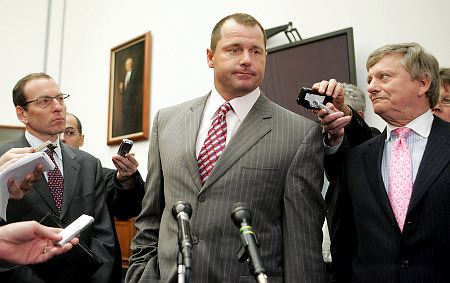
What’s happening to Roger Clemens is a Public Relations teaching opportunity. roger-clemens.79740099

Clemens has been indicted on lying before Congress.

The seven-time Cy Young award-winner was the most dominating pitcher of the steroid era in baseball. That goes to figure, because his former trainer Brian McNamee said the star player took steroids.  Even good friend and former teammate Andy Pettite, who has admitted taking steroids, has confirmed Clemens said he took steroids.

So what does all of this have to do with Public Relations?

Try Rule One of crisis PR: Tell the truth.

My 13-year-old son loves baseball. He plays it every day and lives the game.

Recently, I heard him debating with his friends who the best players of all time might be. When talk turned to Roger Clemens, my son could not figure out what the fuss is all about.

“Everybody knows he took steroids,” my son said. “He should just tell the truth and move on.’’

Great point. When stuck in bad public relations situations, it is paramount to tell the truth as quickly as possible and move on.

But the trouble Clemens faces is not that he is accused of telling a fib to friends, or even a member of the media. The Texas flamethrower is accused of lying to Congress. So now the full force of a federal investigation is bearing down on him.

Clemens proclaims that he never took performance-enhancing drugs. But we have heard that story many times from athletes who later admitted they lied.

The fan in me still hopes that Clemens is being honest. The PR person in me wishes everyone would learn to tell the truth from the beginning.

We’ll see how this plays out. No matter what happens, Clemens’ All-American reputation will never be the same.

alg_roger_clemens

Don’t Take the Bait

AP – Tiger Woods pauses during a press conference.

Two recent news stories reminded me of a good lesson for people facing critical questioning from the media: don’t take the bait.

We expect the media to ask tough, fair questions. It’s their job and that’s what they should do. But sometimes journalists ask questions that go too far or try and bait the interview subject into an uncomfortable situation.

The first story involves Tiger Woods. A reporter at a press conference in Ireland asked him if all his indiscretions has been “worth it” since it cost him his marriage and endorsements.

Obviously, the reporter’s goal is to get him to go ballistic so they can splatter the story all over the British tabloids.

Tiger didn’t take the bait. Woods handled it well, saying “I think you’re looking too deep into this,” and followed up with a very sharp “thank you.”

The second story comes from Sports Illustrated. It’s a Gary Smith article on the Gulf oil spill (yes, an oil spill story in SI, and well worth reading). Smith went on an oily field trip with BP’s crisis commander Bob Dudley, Louisiana Governor Bobby Jindal and a couple of network TV crews.

They wade into a large pool of oil, survey the damage and talk about having to see it to really get a feel for the damage that has been done.

Smith describes the scene after that:

Kerry Sanders, the NBC correspondent, wanted more. “Look over your shoulder,” Sanders ordered Dudley , camera rolling. “What do you see?”

“It’s devastating … it’s very emotional.”

"This is oil from right here." - BP’s crisis commander Bob Dudley

Not enough. “Can we see it on your hands,” demanded Sanders, “and can you tell us what it is?”

Dudley, on a contrition mission, scooped up the goo and gave NBC its money shot, blood on his hands. “This is oil from right here,” he recited dully.

Not enough. From the railing of a boat that the group had climbed aboard, CBS’s Harry Smith pointed to a phalanx of orange, fist-sized tar balls. “This is your oil,” declared Harry. “Do you feel guilty?”

Dudley, hangdog but litigation-leery: “I just feel sad.”

Dudley took the bait from Sanders and shoved his hands in the oil when asked. With BP’s lack of PR preparedness, Sanders probably could have had him in the oil floating on a raft sipping a cocktail – “now hold your drink in one hand and that dead bird in the other.”

Dudley should have gone out there and stuck with professional, responsible answers and not played into the hands of TV reporters trying to manufacture a “moment” for their stories.

I’m not trying to defend Tiger Woods or BP. The point is that anyone in the media spotlight better be able to recognize when the bait is tossed in front of them and know how to avoid it.

Larry King is Hanging up his Suspenders

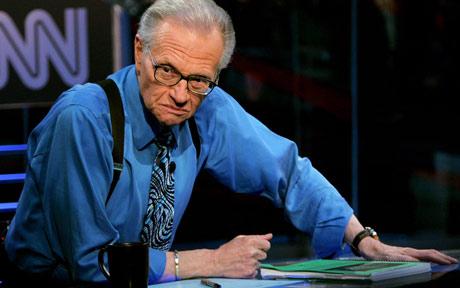
Larry King announces his retirement after 25-year gig on CNN.

Larry King announced that he is retiring from his prime-time cable TV interview show on CNN, where he has been asking the tough questions to celebrities, world leaders and people in the news for a quarter century.

For me, the announcement is not just a sad note for King, but also an indicator of how long I have been in the news business. While all the American media have been talking about how King is a pioneer in cable news, I was stuck with the thought that I remember King vividly as a national late-night/early morning radio talk show host. It was on radio that he deftly honed his interview skills making him adept at talking with anyone and everyone.

Larry King is also a study in media trends. His career has successfully spanned different mediums, but his ability to draw on the latest newsmakers and storylines kept him current for decades.

In the media—as well as in public relations—the mode of how news is delivered is ever changing.  Yet, the power of the story and the storytelling will determine its success.

Good luck, Larry on your next chapter. Who knows? King might start doing interviews on Twitter.

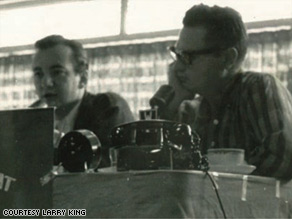
In 1959, Bobby Darin, left, was Larry's first major guest on his WKAT radio program.

The Price of Good PR: Paying for your own Championship Party

54400660[1]Does the price of an NBA Championship include the tab for the citywide celebration after the winning buzzer sounds? In Los Angeles, the answer is yes. 

The Los Angeles Lakers will likely be amending their annual operating budget to include a season-ending party.  In tight economic times, the Lakers ownership faced criticism last year after beating the Orlando Magic for the cost of a parade and citywide celebration. 

After this year’s defeat of the Boston Celtics, the Lakers wasted little time announcing they will pay the bill for the 16th championship parade through the city of Los Angeles. In coordination with city officials, the Lakers response to the potential negative community relations was swift and professional.

The direct response shows that businesses that step up, get in front of the story and take responsibility will be praised in the public light. The Lakers saga shows that even in the height of success, businesses must stay alert to protect their public image.

With this public relations move, the Lakers are champions on the court, as well as off the court.             

54400354[1]

The World Cup of Reputation Management

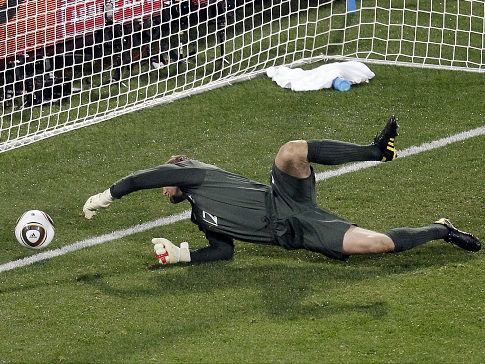
Shot bounces off Robert Green's hands and into the net in the U.S. vs. England's 1-1 tie. (Sohn/AP Robert)

Advertisement for the 2010 World Cup touts that one game changes everything.

How right they are. One defender caught napping—or an unfocused goalie (need we mention England’s Robert Green?)—and a game, if not an entire cup, can be lost.

Lose a game. Lose a chance at greatness.

The same tagline also applies to reputation management.

Just ask Helen Thomas, the veteran White House correspondent, who made some inappropriate and untimely comments about Israelis. She was forced to hastily retire – ending her more than 50-year journalistic career in disgrace.

Just ask the BP CEO Tony Hayward, whose multiple gaffes have made him such easy pickings that the late night joke writers don’t even have to try.  A leadership change at BP would not surprise many insiders.

The only people likely happy with BP’s troubles are Toyota, who have fallen off the front page because their recent mistakes have been washed away by bigger, newer examples of poor reputation management.

One misstep…and years of golden reputation and favorable public image can be tarnished forever.

2025 © Wellons Communications | Orlando PR Firm. All Rights Reserved.